Walk into any great California Spanish Colonial Revival home and feel the floor beneath your feet. Cool. Slightly uneven. Warm in colour even when cold to the touch. That is Saltillo tile — and there is nothing else quite like it in the world.
This post contains affiliate links. If you purchase through them we earn a small commission at no extra cost to you — it helps keep this journal going.
Saltillo tile takes its name from Saltillo, the capital of the Mexican state of Coahuila, where it has been made by hand for over four hundred years. The clay beneath that city — mineral-rich, ancient, laid down in riverbeds over millions of years — produces a tile unlike any other. Each piece is shaped by hand, dried in the sun, and fired in traditional kilns. No two are the same.
It arrived in California with the Spanish missions of the late eighteenth century, carried north as a practical and beautiful solution to the problem of flooring in a warm, dry climate. Once you have walked across a Saltillo floor on a hot California afternoon — cool underfoot, glowing in the slanted light — you understand immediately why it never left.
How Saltillo Tile is Made
The process has remained largely unchanged for centuries. Artisans in Saltillo collect clay from local riverbeds, mix it with water, and press it by hand into wooden molds. The tiles are then laid outside to dry in the sun for several days before being stacked into traditional wood-fired kilns and fired at high temperature for up to 36 hours.
"Each tile is a record of the hands that made it, the sun that dried it, the fire that hardened it. You are not buying a product — you are inheriting a process."

A Moorish arch casts its shadow across the tile — the geometry of light and terracotta that defines the California Spanish Colonial interior at its most poetic.
The result of this entirely handmade process is a tile with natural variations in colour, texture, and dimension that no factory can replicate. Tones range from pale gold and burnt orange to deep terracotta and rich brown, depending on the mineral content of the clay and the heat of the kiln. Some tiles carry the marks of animals who walked across them while they dried in the sun — paw prints that are, in some traditions, considered a sign of good luck.

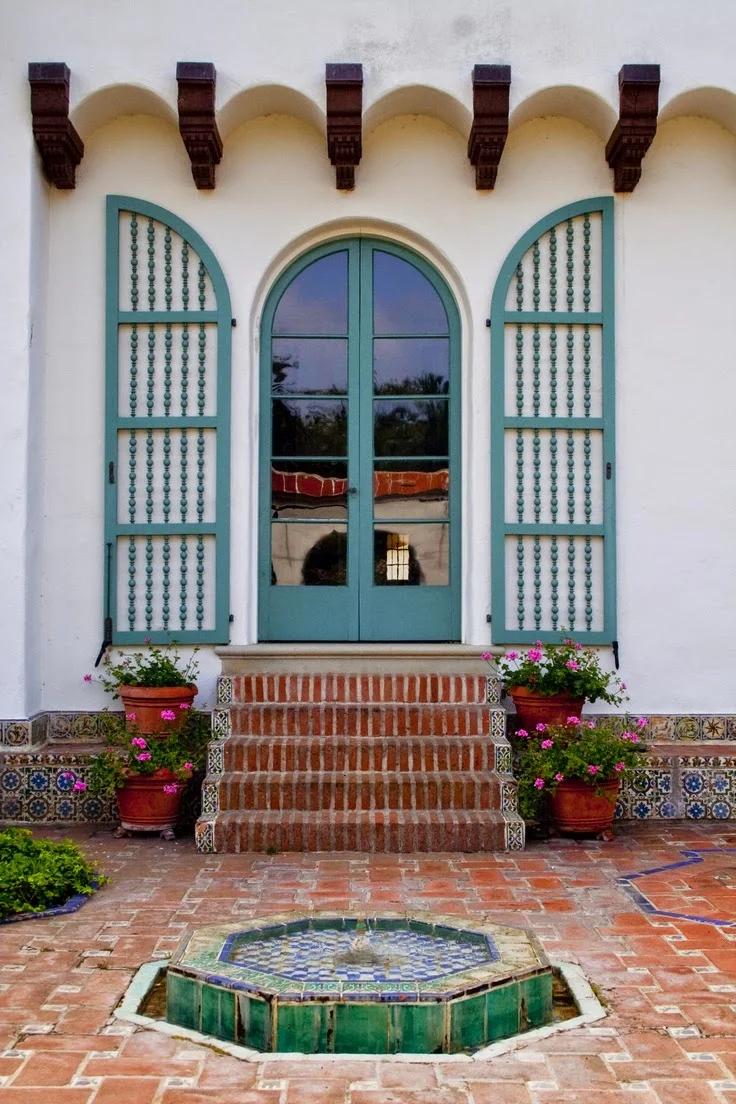
Arabesque-cut Saltillo alongside hand-painted talavera stair risers — two of Mexico's great tile traditions in conversation.
Using Saltillo in Your Home
Where it works best
Saltillo tile is ideal for any space where you want warmth, character, and a connection to the landscape of Southern California. It is most at home in entryways, living rooms, kitchens, and covered outdoor patios. Its thermal mass — the way it absorbs heat during the day and releases it slowly at night — makes it particularly well suited to California's climate.
In a Spanish Colonial Revival home, Saltillo floors are not merely practical — they are the foundation of the entire aesthetic. The warm terracotta tones harmonise with whitewashed plaster walls, dark wooden beams, wrought iron fixtures, and the jewel-like colours of hand-painted Talavera accents.
Design Tip
For a classic California look, mix standard Saltillo squares with decorative Talavera inserts at regular intervals — typically one insert for every nine field tiles. This pattern, common in mission-era buildings, brings colour and rhythm to a floor without overwhelming it.
Sealing — the essential step
Because Saltillo tile is unglazed and porous, it must be sealed before use and resealed periodically. An unsealed Saltillo floor will stain easily and absorb moisture. A properly sealed floor, however, is remarkably durable — many of the Saltillo floors in California's oldest homes have been in continuous use for over a century.
Caring for Saltillo Tile
A well-maintained Saltillo floor will last a lifetime. The basic rules are simple: sweep regularly, mop with a pH-neutral cleaner, avoid harsh chemicals, and reseal every three to five years depending on traffic. If the floor begins to look dull or loses its warm glow, it is usually a sign that it needs resealing rather than replacing.
Over time, Saltillo tile develops a patina — a slight deepening of tone and a subtle sheen that comes from years of use and care. This is not deterioration. It is the tile becoming more itself, more beautiful, more California.
Further Reading — Affiliate Link
California Romantica by Diane Keaton
For deeper inspiration on how Saltillo tile works within the full vocabulary of California Spanish Colonial design — alongside wrought iron, hand-painted tile, and whitewashed walls — this is the essential reference.
View on AmazonWhere to Source Authentic Saltillo
For a California home, always seek out authentic handmade Saltillo from Saltillo, Coahuila, Mexico — not factory-made imitations. The difference is immediately apparent in person: the weight, the variation in colour, the subtle irregularities of surface that give the floor its soul. Several excellent suppliers ship throughout California and the wider United States.
There is a superstition in the American Southwest and northern Mexico that every house with a Saltillo floor must have a single "protector tile" — one bearing the imprint of an animal's paw — laid in a visible place for good luck. Whether or not you believe it, it is worth looking for one. And if you find it, keep it exactly where it is.
Also Recommended — Affiliate Link
California: Living + Interiors by Diane Dorrans Saeks
The best survey of California interior design ever published — featuring dozens of homes where Saltillo tile, hand-painted ceramics, and whitewashed walls come together into something unforgettable.
View on Amazon
Classic Saltillo with hand-painted talavera inlay — a combination that has been used in California Spanish Colonial homes for over a century.