She designed over sixty homes, built an entire community from scratch, drew inspiration from a journey through southern Spain, and died at forty-nine with her name barely known outside San Diego. Lilian Rice was one of the great architects of California's golden age — and it took nearly a century to recognise her.
Drive through Rancho Santa Fe today — past the whitewashed walls draped in bougainvillea, past the clay tile roofs and the deep-set arched windows, past the inn on Paseo Delicias with its shaded arcade and its fountain — and you are driving through the life's work of one woman. Lilian Jeannette Rice designed this place. She planned its streets, drew its buildings, oversaw its construction, and lived within it until she died. Rancho Santa Fe is, more than almost anywhere else in California, a single architect's vision made real.
And yet for most of the twentieth century, almost nobody knew her name.
A Southern California Beginning
Lilian Rice was born on June 12, 1889, in National City, California, ten miles north of the Mexican border in San Diego County. Her father was an educator, her mother an artist — a combination that gave her both rigorous habits of mind and a deep feeling for beauty. In 1906 she entered the University of California at Berkeley, where she was one of the first women to study architecture at the school.
She excelled. Her transcripts record passes in every subject, including descriptive geometry, which defeated many of her male classmates. She joined the school's Architectural Association, took on leadership roles, and graduated in 1910 with a degree that almost no woman in California had yet earned. Then, quietly and without fanfare, she returned home to National City to care for her invalid mother.
"She insisted on three things in her designs: restraint in decoration, high-quality craftsmanship, and harmony between a home and its site."
— New York Times obituary, Overlooked series
Lilian Jeannette Rice — a formal portrait. She was one of the first women to graduate from UC Berkeley's architecture program, in 1910, and went on to become the tenth woman licensed as an architect in California. Courtesy: Rancho Santa Fe Historical Society.
For the next decade she taught — geometric drawing at San Diego High School, then at San Diego State Teachers College — while taking on small architectural commissions wherever she could find them. It was not the career her Berkeley degree had promised. But it was building something: a precise eye, a deep knowledge of materials and craft, and a growing feeling for the landscape of Southern California that would eventually define everything she made.
The Commission That Changed Everything
In 1921, Rice joined the San Diego architectural firm of Requa and Jackson. The timing was, as it turned out, perfect. The following year, the Santa Fe Land Improvement Company — the real estate arm of the Atchison, Topeka and Santa Fe Railroad — commissioned Requa and Jackson to design a planned community on 9,000 acres of old Spanish land grant north of San Diego. The railroad had originally planted the land with eucalyptus trees to supply timber for railroad ties; when the eucalyptus proved unsuitable for the purpose, they decided to develop the land instead.
Requa turned the entire project over to Rice. The thirty-three mile distance from San Diego made frequent site visits impractical for the firm's senior partners, and the financial returns were modest compared to other commissions available in the city. For Rice, it was the opportunity of a lifetime.

A September 1927 advertisement for Rancho Santa Fe — "Acres at a fraction of the price of a city lot... in a genuine Spanish atmosphere." Rice's whitewashed stucco walls and tiled fountain were the face of the community's marketing. Courtesy: Rancho Santa Fe Historical Society.
A Journey Through Spain
In 1925, Rice travelled to Spain. She was thirty-six years old and had been working at Rancho Santa Fe for three years. She carried a camera and a sketchbook, and over the course of her trip she took hundreds of photographs and made constant drawings — of doorways, courtyards, street corners, roof lines, the way walls met the ground, the way windows were set into thick plaster.
She found what she was looking for in Tarifa, the ancient town at Spain's southernmost tip where the Atlantic meets the Mediterranean. Tarifa's Moorish and Andalusian architecture — its whitewashed cubic houses, red-tiled roofs, narrow cobbled streets, and simple geometric forms — crystallised something she had been reaching toward for years. When she returned to California, the language of Rancho Santa Fe deepened and clarified. The rounded corners, the deep-set windows with their decorative wrought iron grills, the horizontally flowing buildings with their restrained and elegant ornamentation — all of it sharpened into something distinctly her own.
The Architecture Itself
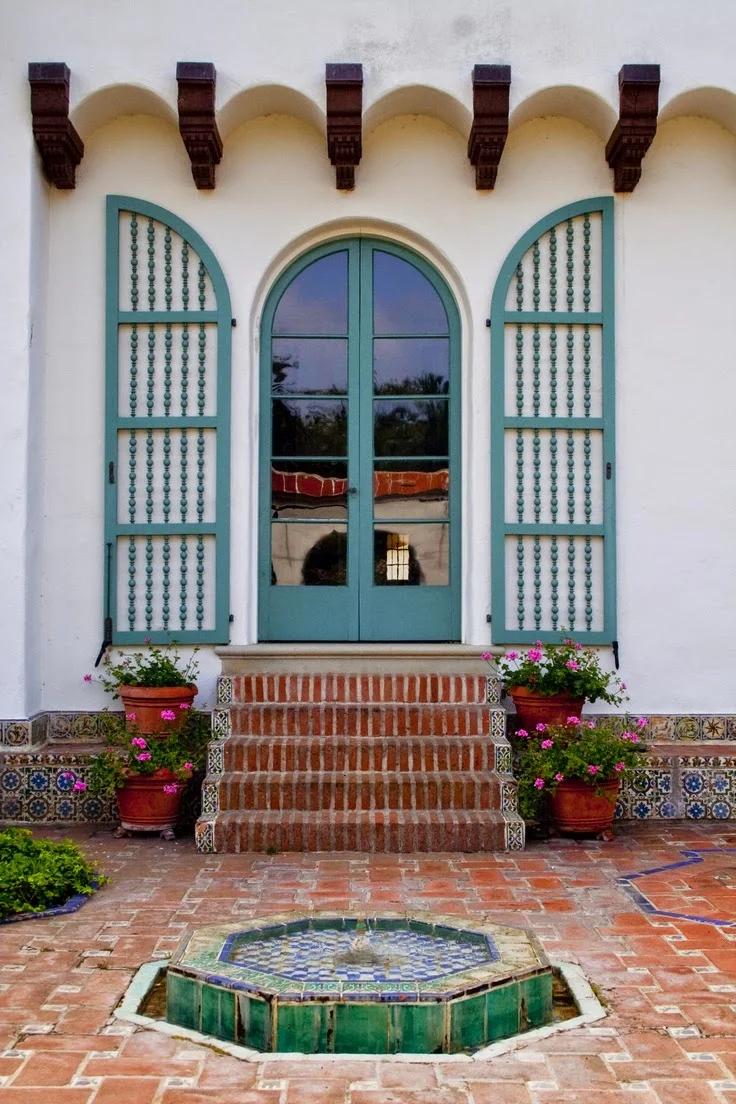
What makes a Rice house recognisable is not any single dramatic gesture but a quality of rightness — the feeling that each building has always been exactly where it is, grown from the soil rather than placed upon it. Her signature was restraint. Where other architects of the Spanish Colonial Revival reached for grandeur and ornament, Rice reached for simplicity and craft. Rounded plaster corners. Tile roofs with varied ridgelines. Deep-set windows that framed light rather than simply admitting it. Gardens that were integral to the design, not afterthoughts.
She designed as much for the community as for her individual clients. The civic core of Rancho Santa Fe — the inn, the post office, the row houses along Paseo Delicias, the garage, the school — was conceived as a unified whole, a Spanish village transplanted to the hills of San Diego County and made entirely Californian. Walking through it today, a century after she drew it, the coherence is still palpable. Everything belongs.

Color survey photographs of Rice's surviving buildings in Rancho Santa Fe: the original civic center service station with its red tile roof (top left); the decorative iron grillework she used throughout (top center); early construction showing the raw adobe massing (top right); a residential example with her characteristic stone path and tropical planting (bottom left); and the Moore Rowhouse on Paseo Delicias (bottom right) — one of four she designed in emulation of Spanish urban residences. Photos: Historic American Buildings Survey, Library of Congress (public domain).
Bing Crosby and the Osuna Adobe
Among Rice's most fascinating commissions was the remodelling of the Juan María Osuna Adobe for Bing Crosby in 1934 and again in 1937. Crosby had purchased one of the oldest surviving adobes in the region and wanted it transformed into a comfortable modern home while preserving its historic character. Rice navigated that tension with her characteristic delicacy — expanding the house, updating its amenities, and deepening its connection to the California landscape, all without disturbing the quality that had made it worth preserving in the first place.
Recommended Reading — Affiliate Link
Lilian J. Rice: Architect of Rancho Santa Fe, California
The world's first monograph on Rice, written by her official biographer Diane Y. Welch after a decade of research. Features 394 illustrations including floor plans, architectural renderings, and stunning photographs of her surviving buildings. Essential reading.
View on Amazon
A later Rancho Santa Fe promotional brochure. Courtesy: Rancho Santa Fe Historical Society.
Recognition — and Its Long Delay
Rice opened her own firm in 1928 and received her architect's license the following year — she was the tenth woman in California to hold one. In 1931 she became a member of the American Institute of Architects, one of only a handful of women admitted at the time. She won AIA awards for three of her projects and received a prize from House Beautiful magazine for a house in Escondido. She hired other women to work with her, including fellow Berkeley alumna Olive Chadeayne, who remained with the firm until Rice's death.
In July 1938, Rice was diagnosed with ovarian cancer. She died on December 22 of that year, at forty-nine, at her home in Rancho Santa Fe — the community she had spent sixteen years building. She was cremated and her remains interred at La Vista Memorial Park in National City, where she had been born.
For decades after her death, her contribution was largely overlooked. The buildings she designed were attributed to Requa, or to the Santa Fe Land Improvement Company, or simply to no one at all. It was not until the work of biographer Diane Y. Welch, and the inclusion of Rice in the Pioneering Women of American Architecture project in 2018, that her story began to reach a wider audience. The New York Times finally ran her obituary — seventy-eight years after her death — as part of its Overlooked series, dedicated to remarkable people the paper had failed to cover at the time of their passing.
Today, thirteen of her buildings are on the National Register of Historic Places. An elementary school in Chula Vista bears her name. And in Rancho Santa Fe, the community she shaped with such care and such feeling for the California landscape, people still seek out a Lilian Rice house the way they seek out a Neff in Beverly Hills or a Smith in Santa Barbara — knowing that what they are looking for is something irreplaceable.
Also Recommended — Affiliate Link
California Romantica by Diane Keaton
The book that inspired this journal — a gorgeous photographic portrait of California's Spanish Colonial Revival homes. Rice's tradition runs through every page.
View on Amazon